 Inversefinance
 lets you borrow through FiRM with collateral and DBR or deposit DOLA into sDOLA
Inversefinance lets you borrow DOLA through FiRM using accepted collateral and DOLA Borrowing Rights, or DBR. Depositing DOLA into sDOLA creates a separate savings position that compounds DBR rewards into DOLA. These jobs can begin independently: a savings deposit does not require opening a loan. Borrowing leaves collateral pledged against debt, so collateral value and remaining DBR coverage both matter. Saving exchanges DOLA for vault shares whose redemption value reflects accumulated rewards. Start by deciding whether the required outcome is additional DOLA liquidity or a yield-bearing DOLA holding, because that choice determines the assets, approvals, and continuing obligations involved.
Updated -
Find a section
Bottom line: Fully repaying DOLA debt does not clear an existing DBR deficit, which still blocks FiRM collateral withdrawal.
Separate balances for FiRM and sDOLA
FiRM provides DOLA liquidity while preserving exposure to an asset that its collateral market accepts. A deposit moves collateral into a Personal Collateral Escrow, where it supports borrowing capacity. The loan creates debt separately from that deposited balance. Collateral is never lent to other users, although liquidation can transfer it to a liquidator. Both FiRM borrowing and the sDOLA deposit workflow described here operate on Ethereum mainnet and require ETH for transaction fees.
Existing DOLA can enter sDOLA directly, without creating collateral debt or buying DBR to fund a personal loan.
How do you open a FiRM loan without selling collateral?
With an eligible collateral market and sufficient DBR coverage, FiRM lets you borrow DOLA while collateral remains in a personal escrow. Contract-based borrowing also requires an approved caller under the borrow-controller rules.
Market and borrow preparation
- Select an Ethereum market that accepts the exact collateral token and permits new borrowing.
- Enter the collateral deposit and DOLA loan amounts, keeping total debt within the market credit limit and at or above any configured minimum debt. A request that would leave total debt below that minimum is rejected.
- Choose the DBR coverage period, using existing DBR or the integrated purchase option.
- Review the resulting debt, collateral ratio, and DBR depletion date in the transaction preview.
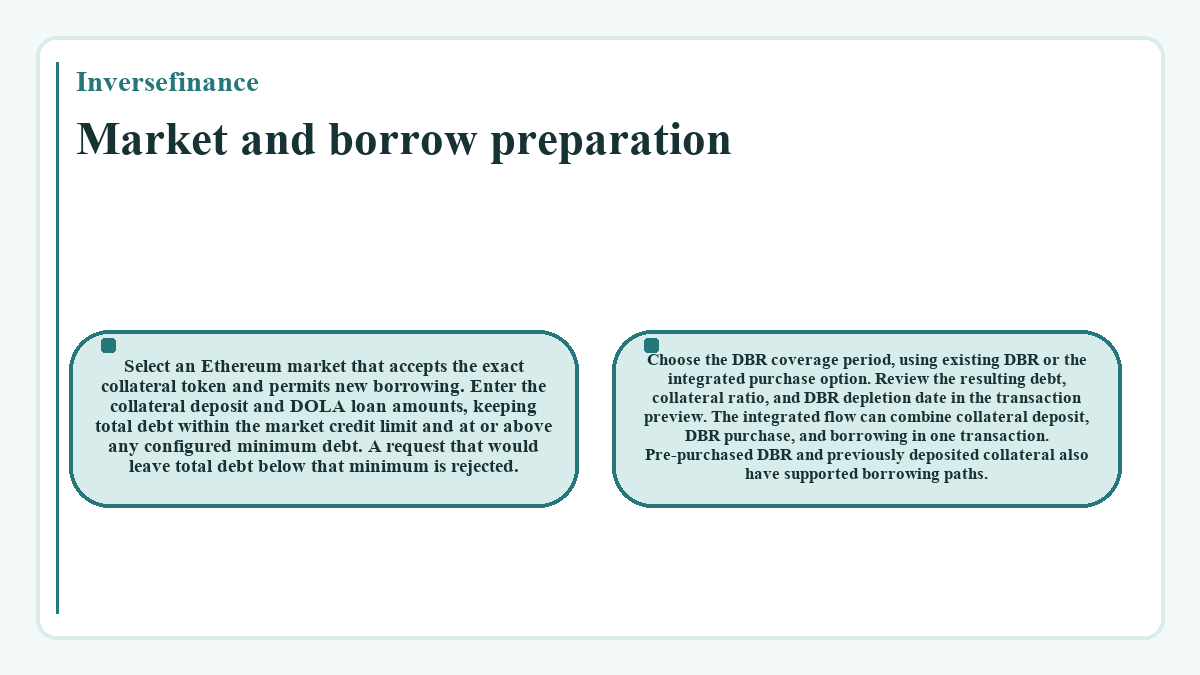
The integrated flow can combine collateral deposit, DBR purchase, and borrowing in one transaction. Pre-purchased DBR and previously deposited collateral also have supported borrowing paths.
Permission and execution
Collateral approval
A required token approval authorizes collateral spending. Approval alone does not deposit the asset, create DOLA debt, or establish that borrowing succeeded.
Active debt
The borrow transaction must execute successfully before the loan exists. Completion appears in the market debt record and the DOLA received through the selected flow. Compare the posted debt, collateral balance, and remaining DBR coverage with the transaction preview. A submitted transaction that has not executed does not establish these changes.
FiRM loan and sDOLA vault parameters
FiRM collateral records, DOLA debt, and sDOLA shares measure different things. Market settings can also change through governance.
| Parameter | Value or rule | Applicable position | Practical limit |
|---|---|---|---|
| Collateral custody | Personal Collateral Escrow | One borrower in one FiRM market | Pledged collateral remains subject to liquidation |
| Credit limit | Oracle-valued collateral multiplied by the market collateral factor | Selected FiRM market | Debt above this limit becomes eligible for liquidation |
| Loan maturity | No fixed expiry | FiRM debt with maintained collateral and DBR coverage | Later DBR purchases use their later acquisition price |
| INV-backed new borrowing | Paused by mill 389, executed June 24, 2026 | FiRM INV market | Existing positions retain repayment and permitted withdrawal functions |
| Savings accounting | ERC-4626 vault shares | sDOLA deposits on Ethereum | DOLA per share follows the vault conversion rate |
| Savings lockup | No contractual lockup period | sDOLA redemption at the vault exchange rate | Redemption returns DOLA and retains DOLA peg exposure |
Debt management before collateral withdrawal
One DBR covers one DOLA of FiRM debt for one year. Coverage funded by DBR already purchased retains that acquisition cost. Extending coverage through later purchases introduces the price available at those purchases.
Adding collateral increases the credit buffer; repaying DOLA reduces the debt that this buffer must support. With debt outstanding, collateral withdrawal must leave enough collateral to support the remaining debt and requires no DBR deficit. If debt exceeds the market credit limit, a liquidator can repay eligible debt and seize collateral with the configured incentive.
A DBR deficit permits external callers to trigger forced replenishment under the market rules. A successful replenishment adds its cost to DOLA debt without sending that amount to the borrower. The charge addresses accrued borrowing time, leaving future coverage to be funded.
After full DOLA repayment, verify that your debt in that market is zero. Cover any remaining DBR deficit with DBR before withdrawing collateral, then check the escrow balance and collateral received.
What happens when you deposit DOLA into sDOLA?
A DOLA deposit on Ethereum mainnet mints sDOLA vault shares, which redeem back into DOLA at the prevailing vault exchange rate. Where a DOLA allowance is required, approval precedes minting. Review the expected share output before confirming the deposit. After execution, check the sDOLA received and DOLA spent. The resulting sDOLA holding represents a claim on underlying DOLA.
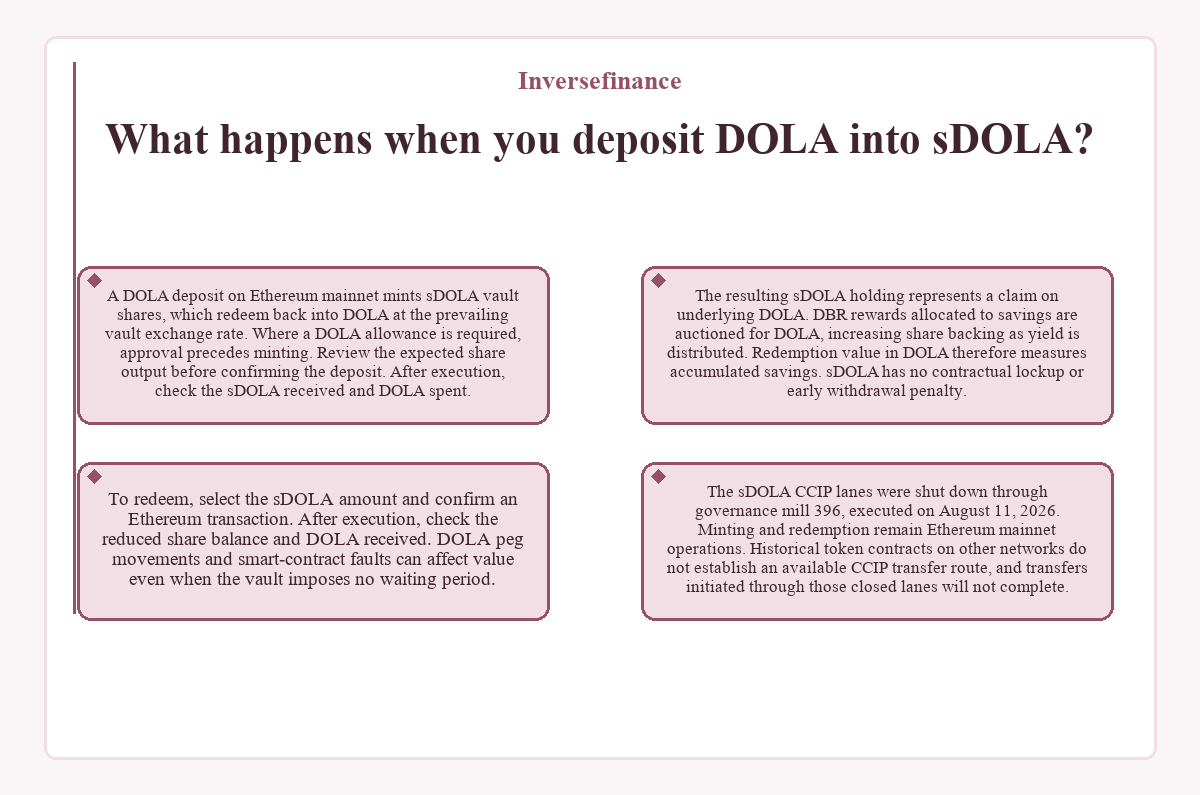
DBR rewards allocated to savings are auctioned for DOLA, increasing share backing as yield is distributed. Redemption value in DOLA therefore measures accumulated savings. sDOLA has no contractual lockup or early withdrawal penalty. To redeem, select the sDOLA amount and confirm an Ethereum transaction. After execution, check the reduced share balance and DOLA received. DOLA peg movements and smart-contract faults can affect value even when the vault imposes no waiting period.
The sDOLA CCIP lanes were shut down through governance mill 396, executed on August 11, 2026. Minting and redemption remain Ethereum mainnet operations. Historical token contracts on other networks do not establish an available CCIP transfer route, and transfers initiated through those closed lanes will not complete.
Leverage and borrowing-funded savings
Leverage uses borrowed DOLA to acquire and deposit more collateral, increasing both collateral exposure and outstanding debt. The Accelerated Leverage Engine, or ALE, can execute this loop in one transaction. Its preview includes final collateral, total debt, liquidation price, and DBR depletion date. A larger debt consumes borrowing rights faster. Leverage amplifies collateral losses and increases liquidation risk.
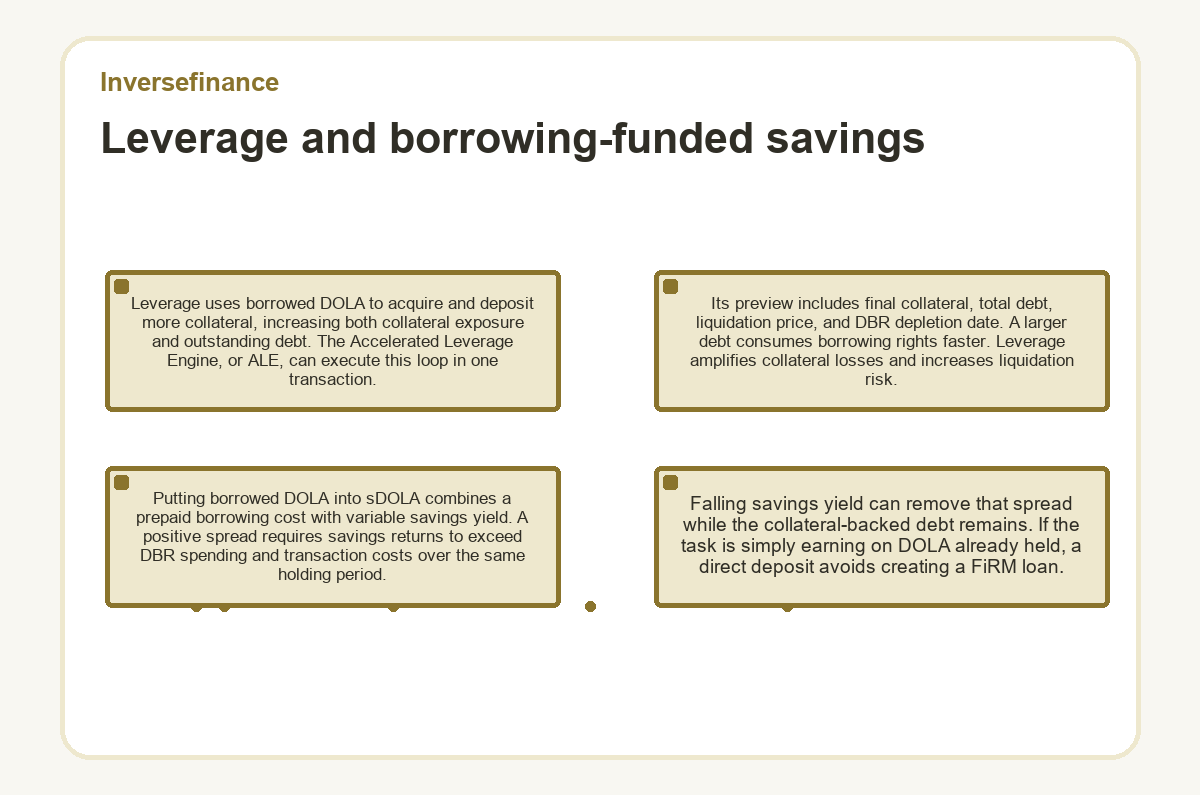
Putting borrowed DOLA into sDOLA combines a prepaid borrowing cost with variable savings yield. A positive spread requires savings returns to exceed DBR spending and transaction costs over the same holding period. Falling savings yield can remove that spread while the collateral-backed debt remains. If the task is simply earning on DOLA already held, a direct deposit avoids creating a FiRM loan.
Inversefinance: questions and answers
Must INV be purchased before borrowing DOLA on FiRM?
INV ownership is not a prerequisite for a standard FiRM loan. The borrowing requirements concern accepted collateral, DBR coverage, and the selected market rules. INV has a governance role, and buying it does not replace the collateral or borrowing rights required by another market.
Can existing collateral support an additional DOLA loan?
Existing collateral can support more DOLA borrowing when unused credit remains and the market permits the increase. The larger debt also requires sufficient DBR coverage. A collateral balance alone does not establish capacity if borrowing caps or a market pause prevent new debt.
How does partial repayment affect later DBR consumption?
Partial DOLA repayment lowers future DBR consumption because consumption is proportional to the remaining debt. It does not undo borrowing time already consumed. An existing DBR deficit therefore needs separate attention, even after the principal balance falls.
Are Ethereum gas fees included in a FiRM DBR quote?
Ethereum gas is a separate transaction cost from the price paid for DBR. Approvals and loan transactions can each require gas. The amount spent on borrowing rights therefore does not represent the full cost of opening or adjusting a position.
What happens to an existing loan during an oracle staleness block?
An oracle staleness block prevents new borrowing while price data is too old under the market settings. Existing borrowers can still add collateral or repay DOLA.
Does minted sDOLA require another staking action to earn rewards?
Holding minted sDOLA is sufficient to participate in its automatic reward compounding. The savings mechanism converts allocated DBR rewards into DOLA without a separate claim or restaking transaction from the holder. Earning remains dependent on the rewards that accrue to the vault.
Is an sDOLA deposit preview a guarantee that minting will succeed?
An sDOLA deposit preview estimates share output before execution. The ERC-4626 preview does not check deposit limits or establish that sufficient DOLA has been approved. The executed deposit must satisfy those conditions before shares are issued.