 Inversefinance
 connects fixed-rate DOLA borrowing with yield-bearing savings
Inversefinance is a DeFi DAO offering fixed-rate loans on FiRM and sDOLA savings, both using the dollar-targeting DOLA stablecoin. FiRM borrowers pledge collateral and hold DOLA Borrowing Rights, or DBR, to cover borrowing time. INV holders govern the protocol. These positions serve different purposes and carry different costs, withdrawal terms, and exposure to losses.
Updated -
Borrowing preserves exposure to pledged assets and creates a DOLA liability. Holding a savings token creates a claim on vault assets. Collateral rules, reward conversion, and loss allocation determine what each position holds and what can change its value.
DOLA issuance and its dollar target
DOLA targets one US dollar through collateral-backed issuance and a Peg Stability Module, or PSM, with different controls governing each route. FiRM markets provide DOLA loans against eligible collateral, subject to borrowing limits. The PSM supplies a separate entry point by exchanging USDS for DOLA and holding reserve assets. A purchase on a secondary market transfers existing DOLA between holders. Obtaining DOLA through a swap therefore does not create a personal FiRM loan or require the buyer to hold DBR.
Governance-authorized supply contracts called Feds manage DOLA issuance within approved ceilings. These controls affect available supply, while market liquidity also influences the exchange price. The dollar target does not guarantee that every DOLA trade executes at exactly one dollar.
What makes FiRM borrowing costs fixed?
FiRM fixes the borrowing cost for the period covered by DBR already acquired, because later DBR price movements do not change that purchase cost. Buying additional coverage later introduces the market price available at that later purchase.
One DBR covers one DOLA of debt for one year. Consumption scales with outstanding debt and elapsed time. Partial repayment reduces the consumption attributable to that loan.
Loans have no fixed maturity while sufficient DBR and collateral support the position. Exhausting borrowing rights can expose an open loan to forced replenishment. An external caller can replenish a DBR deficit at the protocol's replenishment rate, adding the charge to DOLA debt. That extra debt also reduces the collateral buffer.
DBR can be acquired before borrowing. The integrated FiRM interface can also combine purchasing DBR, depositing collateral, and borrowing. Depositing collateral alone is another supported starting point.
Collateral custody and liquidation
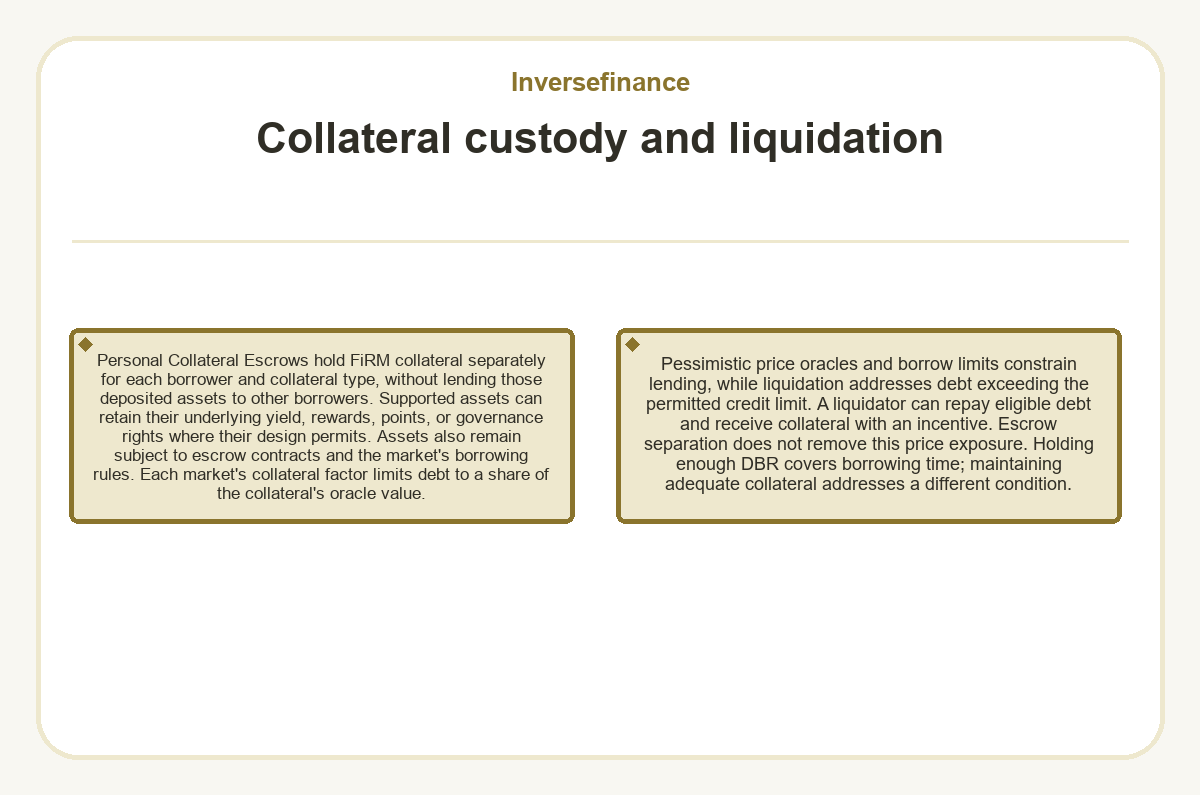
Personal Collateral Escrows hold FiRM collateral separately for each borrower and collateral type, without lending those deposited assets to other borrowers. Supported assets can retain their underlying yield, rewards, points, or governance rights where their design permits. Assets also remain subject to escrow contracts and the market's borrowing rules.
Each market's collateral factor limits debt to a share of the collateral's oracle value. Pessimistic price oracles and borrow limits constrain lending, while liquidation addresses debt exceeding the permitted credit limit. A liquidator can repay eligible debt and receive collateral with an incentive. Escrow separation does not remove this price exposure. Holding enough DBR covers borrowing time; maintaining adequate collateral addresses a different condition.
Parameters behind the token roles
DOLA is the borrowing currency, DBR represents borrowing time, and vault tokens hold asset claims. Redemption assets and voting rights determine what each token gives its holder.
Inversefinance: DOLA in Lending and Yield
- DOLA issuance and its dollar target
- What makes FiRM borrowing costs fixed?
- Collateral custody and liquidation
- Parameters behind the token roles
| Parameter | Value or rule | Control and exposure |
|---|---|---|
| DOLA price target | One US dollar per DOLA | Market trading can diverge from the target |
| DBR borrowing coverage | One DOLA-year per DBR | Outstanding debt consumes the holder's borrowing rights |
| FiRM collateral custody | Personal Collateral Escrow | Collateral stays separate and remains subject to liquidation |
| sDOLA redemption asset | DOLA | Vault shares represent a proportional asset claim |
| sINV voting rights | Wrapped INV does not retain voting rights | Direct INV staking retains governance participation |
| jrDOLA v2 redemption asset | sDOLA | Withdrawals use a queue and can face a governance pause |
| A vault share's exchange rate determines its underlying claim; matching token quantities do not establish matching asset values. | ||
sDOLA savings and auction-funded returns
sDOLA packages DOLA savings in an ERC-4626 vault around the DOLA Savings Account, converting DBR rewards into additional DOLA backing its shares. On-chain auctions exchange the savings allocation of DBR for DOLA. Holders receive the benefit through the share exchange rate without manually claiming or compounding DBR. Deposited DOLA is not lent to third-party borrowers.
sDOLA yield varies with auction revenue and the savings balances sharing distributions. Fixed FiRM borrowing costs do not establish a fixed savings APY. Normal redemptions return DOLA without a maturity lock, through an on-chain transaction. Contract failures and deviations from DOLA's dollar target remain relevant to the holding.
Leverage with yield-bearing collateral
FiRM's Accelerated Leverage Engine, or ALE, combines supported leverage looping within a single transaction, increasing collateral exposure alongside DOLA debt. Its mechanism flash-mints DOLA, swaps it into collateral, deposits that collateral, and borrows DOLA to retire the flash-minted amount. The resulting position still needs DBR coverage and sufficient collateral.
ALE charges no service fee, although swaps and Ethereum gas still contribute to execution costs. Supported leverage depends on the selected market and its parameters. Collateral yield can contribute toward borrowing expenses, while price declines magnify losses on the leveraged position. Points or other rewards remain conditional on the underlying asset's program. A fixed funding cost leaves those returns variable.
INV voting and sINV compounding
INV holders govern protocol decisions, including market risk parameters and treasury allocations, while direct staking can provide DBR streaming rewards. The financial value of INV remains exposed to changes in the token's market price.
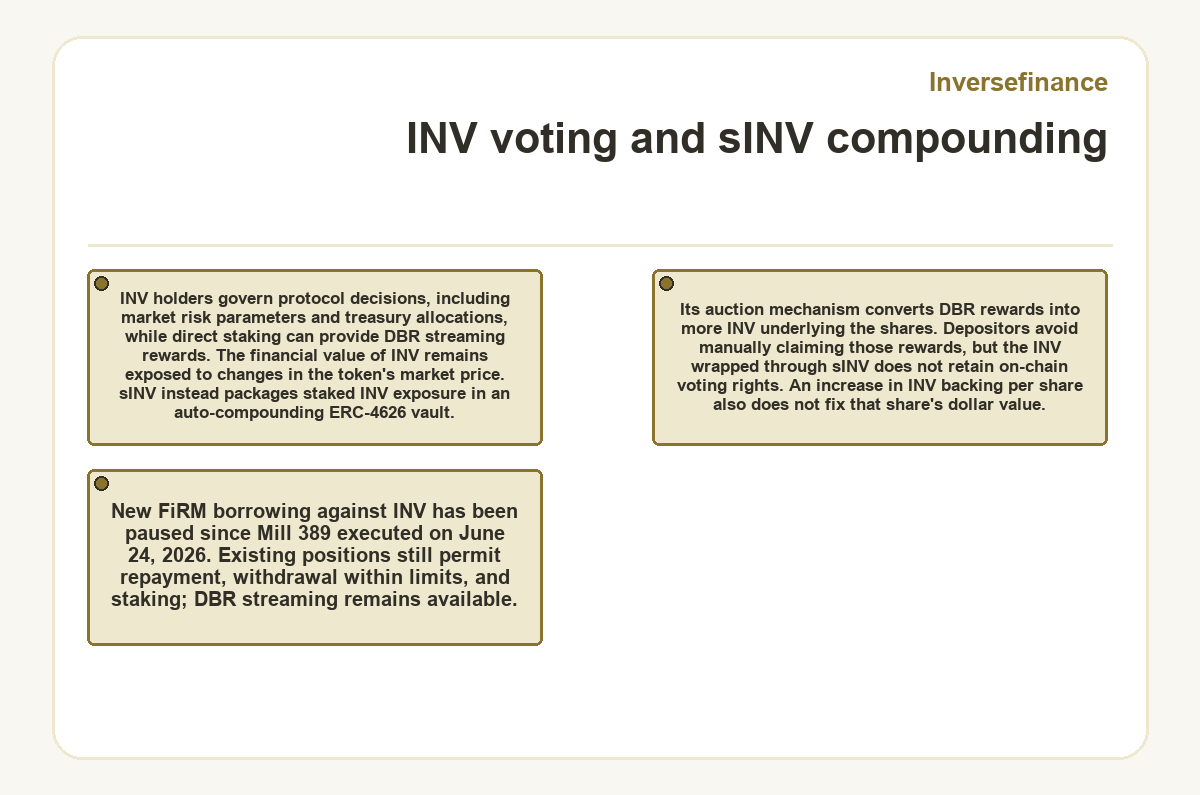
sINV instead packages staked INV exposure in an auto-compounding ERC-4626 vault. Its auction mechanism converts DBR rewards into more INV underlying the shares. Depositors avoid manually claiming those rewards, but the INV wrapped through sINV does not retain on-chain voting rights. An increase in INV backing per share also does not fix that share's dollar value.
New FiRM borrowing against INV has been paused since Mill 389 executed on June 24, 2026. Existing positions still permit repayment, withdrawal within limits, and staking; DBR streaming remains available.
How does jrDOLA change the risk of saving DOLA?
jrDOLA v2 adds first-loss exposure to DOLA savings, offering additional DBR rewards in exchange for capital supporting covered lending losses. Its underlying vault asset is sDOLA. Covered bad-debt events can partially or entirely slash jrDOLA vault capital.
Withdrawals enter a queue and may be paused by governance. Queued capital remains exposed to slashing during the cooldown. Additional rewards can accumulate alongside the sDOLA base yield, yet a covered loss can reduce the underlying value of each share.
Things people ask about Inversefinance
-
What happens to unused DBR after a FiRM loan is repaid?
- Unused DBR remains in the borrower's wallet after repayment and can be retained or sold. Repayment stops consumption attributable to that debt; the borrower's other outstanding FiRM loans continue consuming DBR. Closing a loan does not automatically convert leftover DBR into DOLA or refund its original purchase price.
-
Are sDOLA and sINV still transferable through Chainlink CCIP?
- The Chainlink CCIP routes for sDOLA and sINV are closed. Mill 393, executed on July 21, 2026, closed the sINV lanes; Mill 396, executed on August 11, 2026, closed the sDOLA lanes. These wrappers operate on Ethereum mainnet. Historical deployments on other networks are not live destinations for those transfers, even where receipt-token contracts still exist.
-
Can a smart-contract wallet borrow DOLA on FiRM?
- A smart-contract wallet must have borrowing approval from FiRM's Borrow Controller to initiate a DOLA loan. Depositing collateral and obtaining permission to borrow are separate matters, so a successful deposit does not establish that the depositing contract can borrow.
-
When can a jrDOLA v2 withdrawal be completed?
- A jrDOLA v2 withdrawal requires its queued cooldown to finish and its claim to occur within the exit window. Mill 390, executed on July 5, 2026, set queue-dependent cooldowns of one to ten days and a two-day claim window. Missing that window cancels the request. Governance can extend the wait by pausing withdrawals for up to 90 days per pause action. Under Mill 390, redemption returns sDOLA minus a 5-basis-point fee on the withdrawal amount.
-
Is receiving DBR directly an alternative to sDOLA auto-compounding?
- The DOLA Savings Account allows depositors to earn DBR directly, without sDOLA's automatic conversion into DOLA. The wrapper converts and compounds the rewards; direct DSA participation leaves the depositor holding DBR.